Pages

Saturday, September 7, 2013

Happy Birthday, Henna!
Here are some little creatures I saw this summer to help celebrate your third birthday.  Hope you have a wonderful party!

This summer I have been fortunate to see a number of butterflies and moths.


Butterflies


This first butterfly I found sipping sap from a very old white oak tree near our house.  Its common name is Creole Pearly Eye.  The five eyespots on both forewing and hind wing help identify it. 

This is the underside view of a Question Mark Butterfly that landed on the window at the lab where I work.  It is a brush-footed or four-footed butterfly.  Insects have six legs, but these butterflies have very small brush like front legs, so it looks like it only has four legs.  Can you see the "question marks"?  One question mark is at the end of one of the back legs.  On the other wing you can see one sort of in the middle of the wing.  This butterfly has a cousin called the Comma Butterfly.  It has a mark on each wing that looks like a comma.

This big eyed butterfly is a Silver Spotted Skipper.  It is feeding on a Speedwell blossom.  Can you see the proboscis (a grayish tube) that it is using sip nectar from the bloom?  The butterfly can store this "drinking straw" by coiling it into a small spring shape.


Moths


A Luna Moth came to visit the lab one day.  Actually, we have seen several of these moths this summer at the lab.  This moth has large feather-shaped antenna that it uses to locate a mate by detecting her "aroma".

Another Luna Moth landed on the window a few days later.  This moths are in the silkmoth family.  The caterpillar spins its cocoon from silk that it makes


This is another moth from the silkmoth family.  It is a Tuliptree Silkmoth.  Its caterpillars eat the leaves of yellow poplar which is also called the tulip poplar or tuliptree.  It has sort of a "T-shaped" mark on the forewing and the hind wing.  


I saw this moth at a Moth Event in July at Prairie Ridge EcoStation.  This is a Rosy Maple Moth.  It is also in the silkmoth family.  I love the wonderful pink and yellow colors!  As their name suggests, the caterpillars feed mainly on the leaves of maple trees.

This Rosy Maple Moth landed on the page of a butterfly and moth book that was open to the page that describes it!
There are many kinds of sphinx moths.  This is a Hog Sphinx Moth.  It is also called the Virginia Creeper Sphinx Moth because one of the foods that their caterpillars eat is the leaves of the Virginia Creeper vine.  The adults (moths) feed on the nectar of many different kinds of flowering plants.  They hover like a hummingbird and slip their proboscis into the flower and sip the sweet liquid.


This is a Grape Leaffolder Moth. The caterpillars eat the leaves of grapevines.  When the caterpillar is ready to make its cocoon, it makes three cuts in the leaf it is sitting on.  Then it folds the leaf around itself to make a sort of envelope and closes this pouch with silk.

This is a Tuliptree Beauty Moth.  Its caterpillar is one of the larger "inch worms".  The caterpillar feeds on the leaves of Pawpaws, Sassafras, Poplars, and Tuliptrees.  The moths in the "inch worm" family are also called geometers ("measures the earth") because of the way the caterpillar moves along a leaf.  If the caterpillar is frightened, often it will hold its body stretched out so that it appears to be a small twig.


Click here to see how an "inchworm" moves.


This is a Black-Bordered Lemon Moth.  Its caterpillars eat the leaves of Morning-Glories and certain grasses.  This is another moth I got to see at the Moth Event at Prairie Ridge EcoStation.  To attract the moths, the museum staff hung up lots of white bed-sheets on fences and on the sides of the building.  Then they setup several very bright lights.  The moths would fly in to check out the lights and when tired, would land on the sheets where we could look at them and take pictures.
This little tiny moth is a Southern Emerald Moth.  Its caterpillar is also a geometer, but a much smaller one.  It feeds on the leaves of blackberries and Black-eyed Susan as well as many other plants.
This unusual moth is called the Beautiful Wood Nymph.  Its "nickname" is the "Bird Poop Moth" because it disguises itself on a leaf or a twig as a "splash" of bird poop.


Happy Birthday, Henna!  


Monday, September 2, 2013

Labor Day weekend 2013 - Spiders and Snakes!

I found some neat things in the yard this weekend.  I hope Ethan and Caleb will like looking at these critters.


This is a mother Wolf Spider carrying her egg sac.  It is attached to the end of her abdomen.  Wolf Spiders have four pairs of eyes.  Can you see some of her eyes on the black stripes of her head?  Wolf Spiders are hunters and do not build a web to catch their prey.  They can see well at night as they look for insects in the grass.
This is an Orb Weaver Spider in her web that she builds each night and takes down during the day.  This spider is known as a Cross Spider and sometimes as a Barn Spider.  They often have two white spots at the rear of their abdomen. Can you see them?  In late summer the females get large from a season of feeding on insects of all sizes.  Recently I saw a Cross Spider with a dragonfly in its web that was at least twice the size of the spider.  She finished eating it in less than a day. 


This is a Green Lynx Spider that a coworker found behind the lab a few weeks ago.  It is missing a couple legs.  It is a male spider which we can tell by the two short pedipalps that have "club" shaped ends.  Look at the area at the top of its head.  Maybe you can see a row of four small eyes with two larger eyes beneath those and two more smaller eyes below and between the larger pair of eyes.  These guys are not venomous to humans.  They are ambush hunters and wait in the bushes to catch passing insects.  They use the spikes on their legs to help hold their prey.  At one time they were used in cotton fields to eat insects that damaged the cotton plants.

This is the spider that used to scare me.  Now I respect it and watch it carefully.  They are venomous and can hurt us if they bite us.  But they are fairly slow when they walk and I just try to pay attention.  Your great grandmother (Mana) collected two of these spiders for me to take to the museum in Raleigh for other people to see.  I have seen her move them carefully to the field away from her house.  Most people just kill them.  I like it that I am not so afraid of them now.

This is the under side of the mother Black Widow.  The red hour-glass shaped spot is a definite identifying mark of this spider.  The "globe" shape of its abdomen is also a characteristic of black widows.


This is a young Eastern Worm Snake.  They usually have a medium gray back with a light pink belly.  They eat earthworms and slugs.  They will try to "burrow" between your fingers when you hold them.  Sometimes they will drag the pointy end of their tail across your hand.  They usually grow to about 11 inches or so.  They are fun to look at and to hold.  They are very squirmy so it will tickle you a little.  They do not harm people.


This is an adult Rough Earth Snake.  They live in the same places that Worm Snakes live, under rotten logs and wet leaves.  This snake is similar in color to the Worm Snake but has a creamy colored belly.  It also has keeled scales.


If you look closely, you can see the little ridge on each scale.  There is another Earth Snake that lives in North Carolina.  It is called the Smooth Earth Snake.  Each of its scales is smooth and does not have a ridge (keel).  The eye of this individual is cloudy looking.  It will probably be shedding its skin soon because it has out grown this one.


I found this Southern Copperhead snake behind our house earlier this summer.  They are venomous so you don't want to handle them.  They have an attractive color pattern that helps them hide in old leaves.  Their eye pupils are not round like non-venomous snakes, but vertical pupils.  Notice that the snake has darker bands across its body and that the band is narrow along its spine and gets wider as it goes down the sides.  We saw two last year, but many years we don't see one at all.  Often they will vibrate their tail in the leaves to warn that they are nearby.  They would rather bite something they are going to eat (like a mouse) than waste their venom on something big like us.


Friday, June 21, 2013

A House Wren Nest in June

June 21, 2013
This post is for Layla.  
She is 6 years old today.  
Happy Birthday, Layla!

Mr. Rogers, from Mr. Rogers' Neighborhood, used to talk about Troglodytes aedonthe House Wren, on his children's television program.  The name Troglodytes means "cave dweller".  Wrens typically like to nest in "cavities" like a nest-box, but also lots of other places like hanging flower baskets, barbecue grills, window air conditioners, woodpecker holes, and many other unusual places. 

 to see a video clip of a song about this little bird 
http://www.youtube.com/watch?v=dgUZGMMHKPY 


This is a House Wren nest built in a recently erected "bluebird nest-box" in Raleigh, NC.  The male assembled the "dry sticks" that form the base of the nest over a period of a few days.  The female fashioned the "nest cup" using a variety of materials.  


Over the course of several days the male built the foundation for nests in two nest-boxes.  The female chose the first nest-box and eventually laid 5 eggs.  Note the male Northern Cardinal feather in the upper left of the picture.  She has used several kinds of feathers in and around the nest cup.  Each egg is patterned a little differently than the next but they are all cream-colored with reddish-brown speckles.


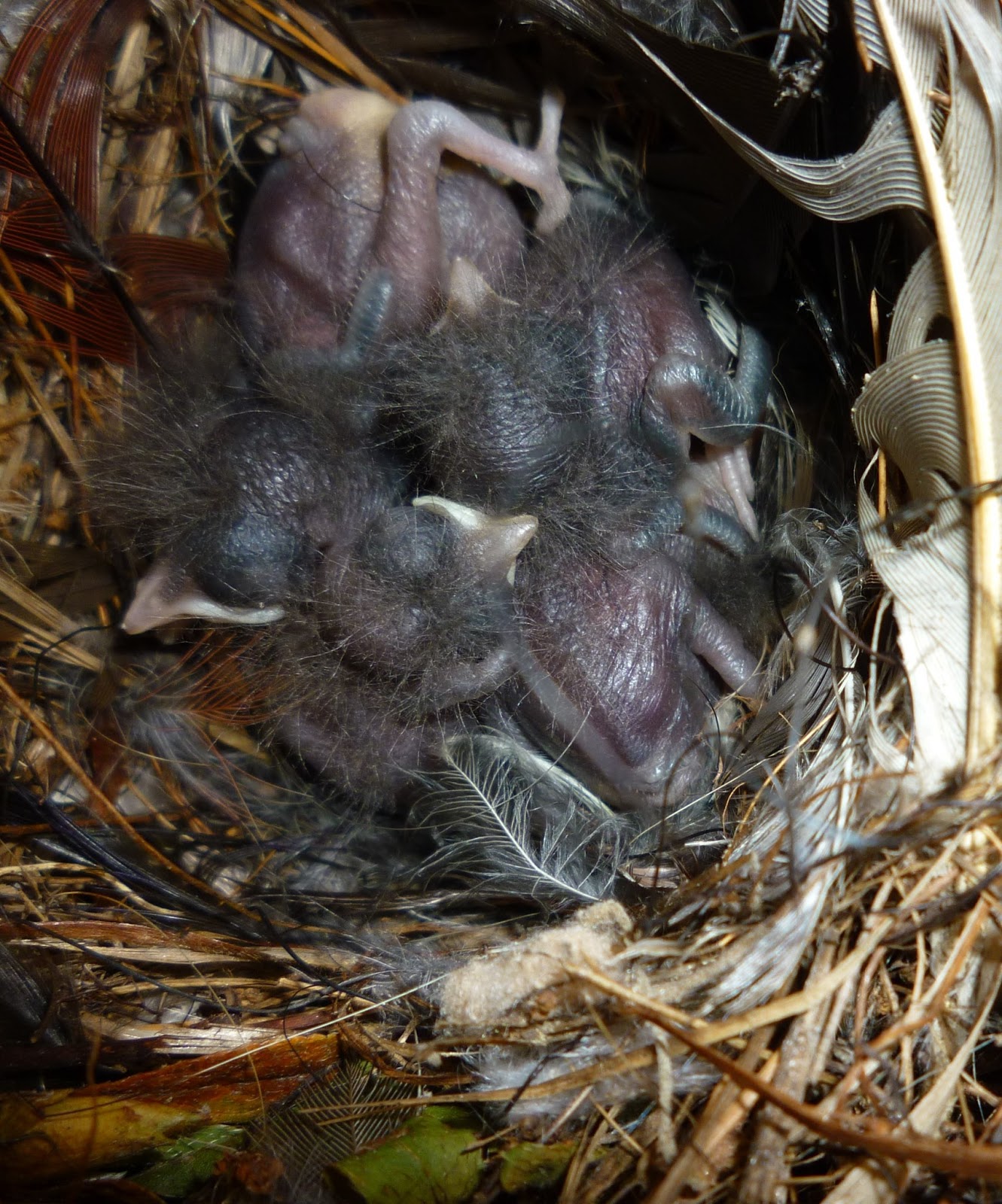
On the morning of June 19th the first three baby wrens hatched.  Their little necks look so long and they seem to have only a few fuzzy feathers on their mostly naked bodies.  They have a lot of growing to do in the next 15 to 17 days when they will be ready to fly. 


By early afternoon on June 19th the fourth and fifth wren chicks hatched.  They are all piled up on each other so they are difficult to count.


On their second day, June 20th, it is easy to count four of the nestlings.  The fifth one is under the "pile".  Their eyes are still unopened.  It seems the nest is full of little wings and legs.


On the morning of their third day, the nestlings are resting comfortably, their eyes still not open.  The mother bird fusses at me from a dogwood tree nearby.  Later the male sings his bubbly song from a deciduous azalea a little further away. 
(June 21st)
Happy Birthday, Layla!


On the morning of their fourth day you can see the opened ear canal on the baby wren at the lower right (you can just see the edge of its beak just below and to the left of the opening). Can you count all five babies? 
(June 22nd)

Mother wren is fussing
with me this morning as
I check-in on her babies.


On the fifth day the feather sheaths become apparent along their wings.  There is something in the nostril of one of the chicks.
(June 23rd)

Still on their fifth day you can see the backs of two chicks heads and the beaks of the other three.
(June 23rd)


Here is close-up of a chick with its eyes still unopened and its beak partially open on the fifth day.
(June 23rd)

On the sixth day the feather sheaths along the wings extend.  Feathers are made of keratin (sounds like "carrot ten"), and is the same material from which our hair, fingernails and toenails are made. 
(June 24th)

On the seventh morning, you can see the brown feather tips beginning to emerge from the feather sheaths.  
(June 25th)

In this close-up on day eight you can see the brown feather tips extending further from the feather sheaths. 
(June 26th)

Again on the eighth day you can see a couple chicks with their eyes open. 
(June 26th)


On the ninth day I found one chick pulled to the front of the nest near the entrance hole.  It was obviously not alive and a few flies had already gathered.  The feathers continue to develop on the other four nestlings.
(June 27th)

In this picture you can see that the little chick's feathers had not developed as much as its siblings.  I am not sure of course, but I suspect this was a weak one who was not able to get its head up to be fed as frequently as the others.  I removed its body from the nest to protect the others from its decaying body.  I buried it under a blooming Rhododendron bush about 50 feet away from the nest. 
(June 27th)
Soon after I buried the little one, a bumblebee that was gathering nectar from the Rhododendron bloom flew off and gave us this in flight picture. 
(June 27th)

It's day ten already and these little birds have really grown.  The parent birds have been busy all day feeding them.  I put out live meal worms on the sidewalk nearby.  The parent bird came and picked up a worm one at a time and banged it on the sidewalk before taking it to the nestlings.
(June 28th)


The nest is filling up with baby birds on day eleven.  You can see some of the striping along the wings starting to appear as the feathers push further out of their sheaths.
(June 29th)

This is another picture from day eleven.
(June 29th)

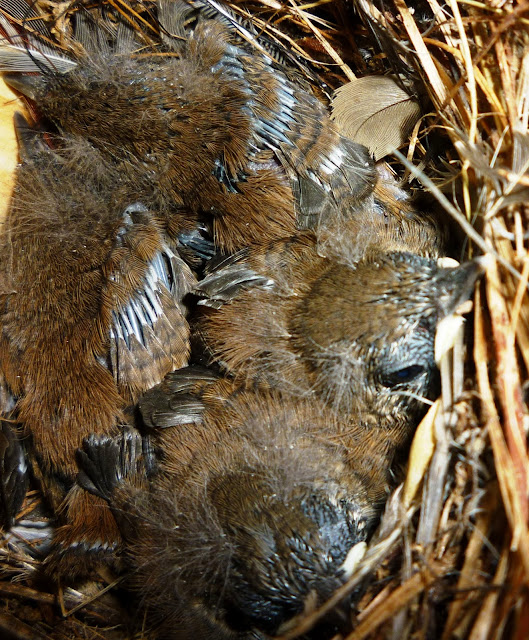
Early on day twelve the feather sheaths are hard to spot as the wing feathers continue to develop. I have read that the sheaths will break off in bits or will be removed by the bird as the feather finishes growing to full length.
(June 30th)

Still early on day twelve (the last day I should be doing this) I slipped one of the little wrens out of the nest-box for less than a minute.  After day twelve there is a risk that the nestling might want to get back out of the nest before it is fully matured and ready to fly.  This little bird was very warm to my palm and clutched my finger with one of its feet.  It went eagerly back into the nest-box. 
(June 30th)

A second picture a few seconds later shows the dark banding across the wing and you can see short sections of the feather sheaths midway along the wing.
(June 30th)


On day 13 all eyes are looking back at the camera.  The parents are staying busy flying bugs to the nest.
(July 1st)

We are getting very leggy in here!
(July 1st)

On day 14 the nest is getting more and more crowded.   The black banding on their wings is getting very prominent.
 (July 2nd)


On day 15 the tail feathers look to be getting longer.
(July 3rd)

On day sixteen both parents have been flying to the nest-box non-stop as they feed these hungry nestlings.  We put out a handful of live mealworms so that there would be plenty of food available.  They look so much like their parents now.  It won't be long till they fly from the nest.
(July 4th - Independence Day)
Early in the morning of day sixteen, two of the babies have fledged.  Their two nest mates won't wait much longer.
(July 5th before 7 a.m.)

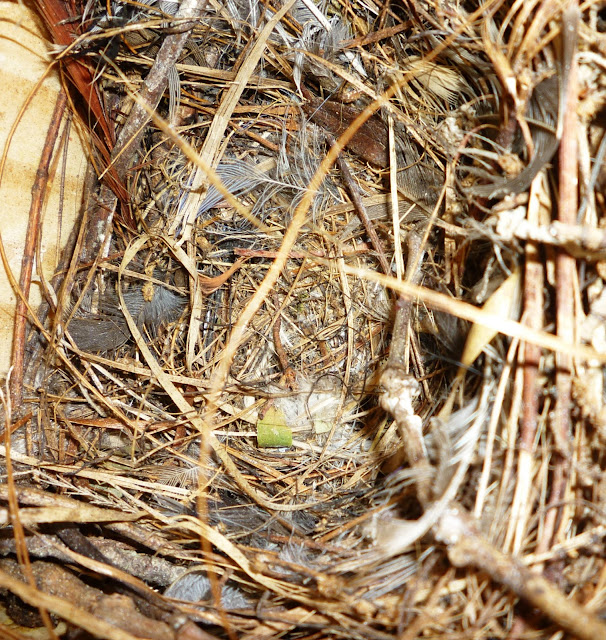
On the morning of day seventeen, the nest is empty.  Four of the five baby birds have successfully flown from the nest.  The parents keep them hidden in the trees and bushes toward the back of the yard and continue to feed them.
(July 6th)

On the morning of the eighteenth day, I heard the male parent singing his bubbly happy sounding song.  Not long later I saw him and the female going in and out of another nest-box about 50 feet away from where they had just raised these four babies.  I checked the nest-box early in the afternoon and found the foundation of twigs and sticks.  These two birds are contemplating nesting again while they tend to the youngsters who left the nest in the past two days.  These are busy, busy House Wrens!


In the middle of a hodge-podge of twigs is a fuzzy white ball.  This is a spider egg-case   When the baby spiders hatch out they will eat any insect parasites in the nest that might otherwise suck on the baby wrens' blood.  It is a way to help keep the babies healthy.

  • As with other bird species, blood-sucking nest parasites can infest a nest and be a problem for the developing nestlings. Some House Wrens have been found to put the egg cases of predatory spiders into the nest material. In a recent laboratory study, when the spiders hatched they fed on the nest parasites and likely improved the health of the nestlings. from http://www.tnwatchablewildlife.org/woodworkingforwildlifedetails.cfm?uid=12102009471782005