Pages

Showing posts with label Carolina Wren. Show all posts

Monday, May 18, 2015

NEST BOX CHECKS MAY 12TH TO 15TH


This has been a busy week in the nest boxes at home and at the lab.  A total of 12 young Eastern Bluebirds successfully flew out of their dark and protective nest boxes into a big bright new world.  Here is the recap.


LAB BOX #1

I checked on the nest in Lab Box #1 twice this week and found either the mother on the nest or one of the adults calling from the tall Loblolly pines nearby.  I am hoping to find hatchlings when I monitor the nest box on Monday (May 18th).


LAB BOX #2


Lab Box #2 had an eventful day on May 12th.  When I removed the plastic nesting cup from the box about 10 a.m. to check the 19 day old nestlings (16 to 21 days is typical age for fledging), one of the three young birds looked up at me and immediately flew strongly straight out from the nest and curved slightly to the left down the hill about 200 feet before landing in a 20 foot maple tree, one of a few young trees that line the drive leading to the lab parking lots.  Within just a few seconds one of its nest mates took off and followed almost an identical flight path. Not long later I could hear the parent birds calling to these first two fliers. The third young bluebird spent a minute or two tucking its head into the bottom of the nest in an effort to hide.  Here you can see the last nestling peeking at me with one of the two eggs from the clutch that did not hatch.  I placed the nesting cup back in the box and checked the box again that evening to find that the third young bluebird had fledged as well. These were my first three fledgling birds of 2015.  I removed the old nesting cup, washed out the inside of the nest box itself, and placed a fresh nesting cup inside in the event this bluebird pair decides to nest again this summer.  Later in the afternoon I opened the unhatched eggs and found nothing but yolk in one egg and just the tiniest amount of tissue in the other.  


LAB BOX #4

The Carolina Chickadees in Lab Box #4 have developed their characteristic black cap.  The five of them seem to be keeping the same arrangement in the nest as they did last week, looking a bit like wedges of pie.  Notice the feathers expanding from their feather sheaths on the nestling nearest my fingers.  They look rather like makeup brushes that I've seen in my wife's makeup kit.  This visit was on May 13th.


LAB BOX #6

The Carolina Chickadees in Lab Box #6 are just a day older than the chickadees in Lab Box #4.  You can see that their wing feathers have emerged even further from their feather sheaths.  This nest of five chickadees seem to arrange themselves in more of a disorganized pile than the orderly circle that their colleagues on the other side of the lab have chosen.


LAB BOX #7

The most recent nest at the lab also belongs to a pair of Carolina Chickadees and is located in Lab Box #7. On May 13th there were still five eggs being incubated.  This box is at the end of a section of parking lot near the lab and may offer a chance for me to share a view of the little chickadees to a few lab mates late next week.


HOME BOX #1

I checked on the Eastern Bluebirds in Home Box #1 on the morning of May 12th before heading to work.  All five young 18 day old birds looked healthy and fully feathered.  That evening, I put several live mealworms in the driveway and sat in my car hoping to get a few photos of parent birds taking food to their young charges. After sitting for a while and not seeing any activity, I got out of the car and checked the nest box.  It was EMPTY!!!  So these were bluebirds 4, 5, 6, 7, and 8 to fledge on this day!


HOME BOX #2


In Home Box #2 the little 15 day old Brown-Headed Nuthatches are fully feathered on May 12th.  The characteristic white patch on the nape of their necks is quite evident.


I lifted one of the young nuthatches out of the nest for a closeup photo. It promptly made a deposit!  Its dagger-like beak will be put to good use in just a week or two as these tiny birds are fond of fishing out insects from behind bark as well as splitting open sunflower and safflower seeds.  I read somewhere recently that some nuthatches have been seen using a piece of bark to wedge behind the bark of trees to expose deeper insect hiding places.


HOME BOX #5


On May 13th the elevated Home Box #5 still holds six little Tufted Titmice.  They are feathering out nicely and I've enjoyed watching from the window as both parent birds busily carry food to their young.


HOME BOX #6


I checked in on Home Box #6 on daily from May 13th (photo) through May 15th. The father bird nearly brushed my shoulder on one dive bombing run.  Early in the morning of May 15th these four nestlings became Bluebirds 9, 10, 11, and 12 to fledge from the nest boxes I've been monitoring.


HOME - RUBBERMAID TRASH CAN


In the late afternoon of May 12th as I began to ready the Moth Pit for luring in various nighttime visitors in the next week or so, I stumbled upon a mass of wheat straw, grasses, small twigs and thin pieces of plant roots in the bottom of a nearly empty light blue Rubbermaid trash can.  Upon closer inspection, I found four whitish eggs speckled with tiny flecks of reddish brown.  This is the nest of a Carolina Wren, but was it active?  I waited until after 9 p.m. and slipped out to take a peek.  I could no longer see the eggs, but could barely make out the beak of the mother wren.  The wrens are such a resourceful bunch!  The next evening there was a fifth egg and the mother bird seems to have set about incubating.


Saturday, May 16, 2015

VISITORS TO THE BIRD ROOM AND DECK


Ruby-Throated Hummingbird

Last Saturday I spent a sometime watching birds from our bird room and the deck. Our first visitor was this male Ruby-Throated Hummingbird.  Like all hummingbirds he was quite busy.  So far this is the best photo I've been able to get.  His gorget appears black in this photo because the sun's rays were obscured by the mature White Oak trees on the south side of the deck.


Eastern Bluebird

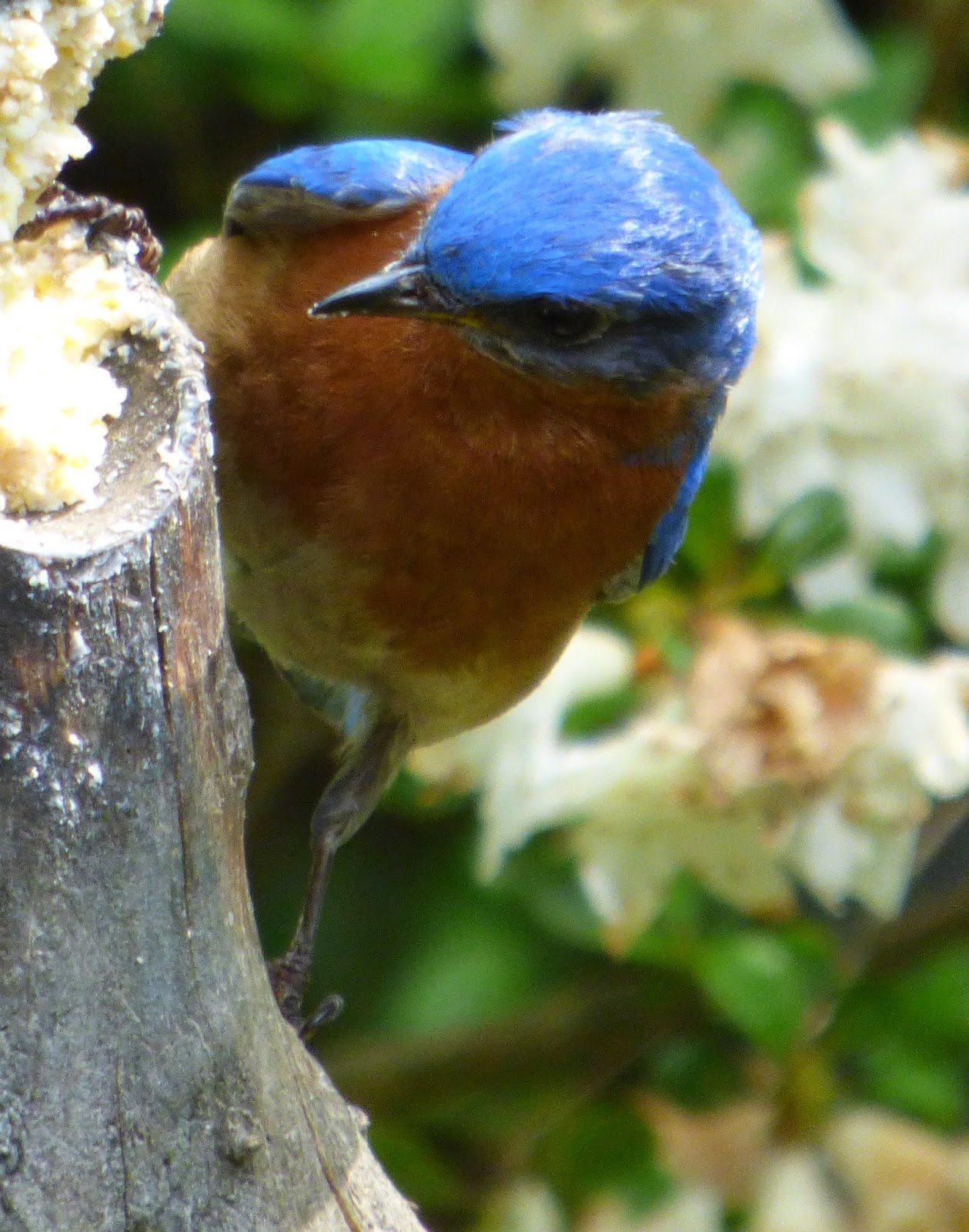
This male Eastern Bluebird was checking the terracotta saucer for live mealworms. His four young nestlings are just five days from fledging and he is as active as his mate in feeding them.


Back inside the bird room, I left the windows open again with a plastic tub of live mealworms on the table nearest one of the windows.  It wasn't long before the female of this pair showed up. She gave me a cautionary glance as I sat quietly with the camera on the other side of the room.  


She gave a few quick wing beats to balance herself as she picked out the one she wanted.  I just love the soft beauty of these female Bluebirds.


She secured the mealworm before flying back out of the window to the nest box that holds her four nestlings.


Carolina Wren

One of the bravest birds is the Carolina Wren.  For such a small bird they have a huge voice.  They creep and skulk around, often close to the ground before darting inside.   The wren's tail is characteristically held in a jaunty position and is rusty brown and marked with dark brown bars.  Their throats and bellies are buff in color and they have pink feet.


Two other characteristics of Carolina Wrens are the long white stripe over the eye and the longish, slightly downward curving beak.  I have been wondering where this bird might have nested.  The pair usually exits the window and then dives down under the deck to some remote location.  I had been looking around to see if I could find their nest, but was very surprised this week when I found a Carolina Wren nest in the bottom of a large Rubbermaid trashcan in the corner of the Moth Pit.  I could see four eggs in the nest around 6 pm that evening.  I returned after dark and peeked over the edge of the trashcan to see just the beak of the mother bird protruding form the nest's opening.  Two mornings later when she was away from the nest, I counted five eggs.  I have a new nest to monitor!


Carolina Chickadee

At least one Carolina Chickadee visited the indoor mealworm feeder.  These little birds are also brave around humans.  They have a soft gray back, a whitish belly and cheeks, and a black cap and throat patch.  We had a nest of chickadees in the yard last year, but this chickadee seems to fly into a neighbor's yard with its mealworms.  At the lab there are currently three active chickadee nests.


In this photo you can see how small the chickadee is using the mealworm for comparison.  They are probably two-thirds the size of the bluebirds.


Tufted Titmouse

The final visitor for the morning was this Tufted Titmouse.  This relative of the little chickadees has a soft gray back and head with a crest  that it sometimes lays close to its head.  Its undersides are whitish with a touch of orange under its wings.  


 Last May we had a nest of titmice that failed about a week after the babies hatched. Something apparently happened to the mother bird.  This year there is a nest of six babies that are now well feathered.  I watched today as both parent birds made frequent trips to the nest with food.


Tuesday, May 5, 2015

MAY 2ND ADULT BIRDS

The weather was quite pleasant on May 2nd, so I opened the windows to the "bird room".  This way I could photograph birds at the feeders without the distortion of the windows' glass.  


CAROLINA WREN


One early visitor came right on inside the room for mealworms from the uncovered plastic mealworm storage container on the table.  It was a small, but big voiced Carolina Wren.  The powerful "tea kettle, tea kettle, tea kettle, tea!" of the Carolina Wren makes it sound much larger.  Here is one of the wrens checking over the hundreds of mealworms available.


A little closer look is in order.


OK, the perfect mealworm is selected.  Or is that two?


Now it's time to check out and head for the nest that the wrens must have nearby.  I have yet to locate it.


EASTERN BLUEBIRD


Of course one of my favorite birds to watch is the Eastern Bluebird.  With two bluebird nests in the yard, each male is busy trying to keep the other bluebird pair away from the mealworms.  But eventually both pairs get their share.  It is interesting to watch these beautiful blue males allow wrens and titmice to feed on mealworms at will, but object when either of the bluebirds from the other pair approach.


Wow, what a magnificent and stately bird.  Watch out, there go those sneaky mealworms heading over the edge of the flower pot saucer!


Here is the female Eastern Bluebird.  Right down the center of her tummy, you can make out a vertical slot where her brood patch is located.  This is a bare area of skin on her abdomen that she uses to keep her eggs warm during incubation and to keep her developing young snug during the first several days after hatching.


I refilled the suet feeder last week to supplement the adult insect-eating birds while they are hunting live insects for their babies.  The bluebirds are taking advantage of this additional supply of energy food.


Male bluebirds are very attractive birds and their behaviors are enjoyable to watch.   


RED-BELLIED WOODPECKER


This handsome Red-bellied Woodpecker visits the suet feeder occasionally.  He also spends plenty of time checking out the overlapping bark on trees in the area looking for insects and spiders.


Now this is a mouthful of suet!


DOWNY WOODPECKER


This female Downy Woodpecker also visits the suet feeder. She is about the same size as the bluebirds.


Woodpeckers have a toe arrangement that is different than most of the songbirds which have three toes pointing forward and one pointing backward.  The Downy has two toes pointed forward and two pointed to the back which helps them in maneuvering around on the bark of trees.


GRAY CATBIRD


The Gray Catbird migrates south in winter while its kin, the Northern Mockingbird and the Brown Thrasher, remain here year round.  These three species are "mimids" that mimic the songs of other birds.  Typically mockingbirds repeat other birds' songs in at least a triplet, while brown thrashers sing doublets of each call before moving on to the next.  Catbirds usually repeat each call just once which gives their song a very rambling nature.  They also have a "mew" call that sounds much like a kitten's.  Gray Catbirds are a uniform slate gray with a black skull cap.


It is nice to see the shy catbirds return in the spring.  There have been a pair visiting the suet feeder and also picking up morsels from under the feeders.  I suspect they may have a nest in some thicket nearby, but I have yet to locate it.  The Gray Catbird has a rusty patch beneath its tail that you can see here.  


WHITE-BREASTED NUTHATCH


The acrobatic White-breasted Nuthatch is a common visitor to seed and suet feeders year round.   They have an impressive beak made for probing under the bark of trees searching for insects, but can also hammer the dickens out of sunflower seed that they often stash in nooks and crannies of trees for later retrieval.


This is a typical pose of the White-breasted Nuthatch, with its head pointed down.  I love to hear their lively "yank, yank, yank, yank" nasally call.


YELLOW-RUMPED WARBLER


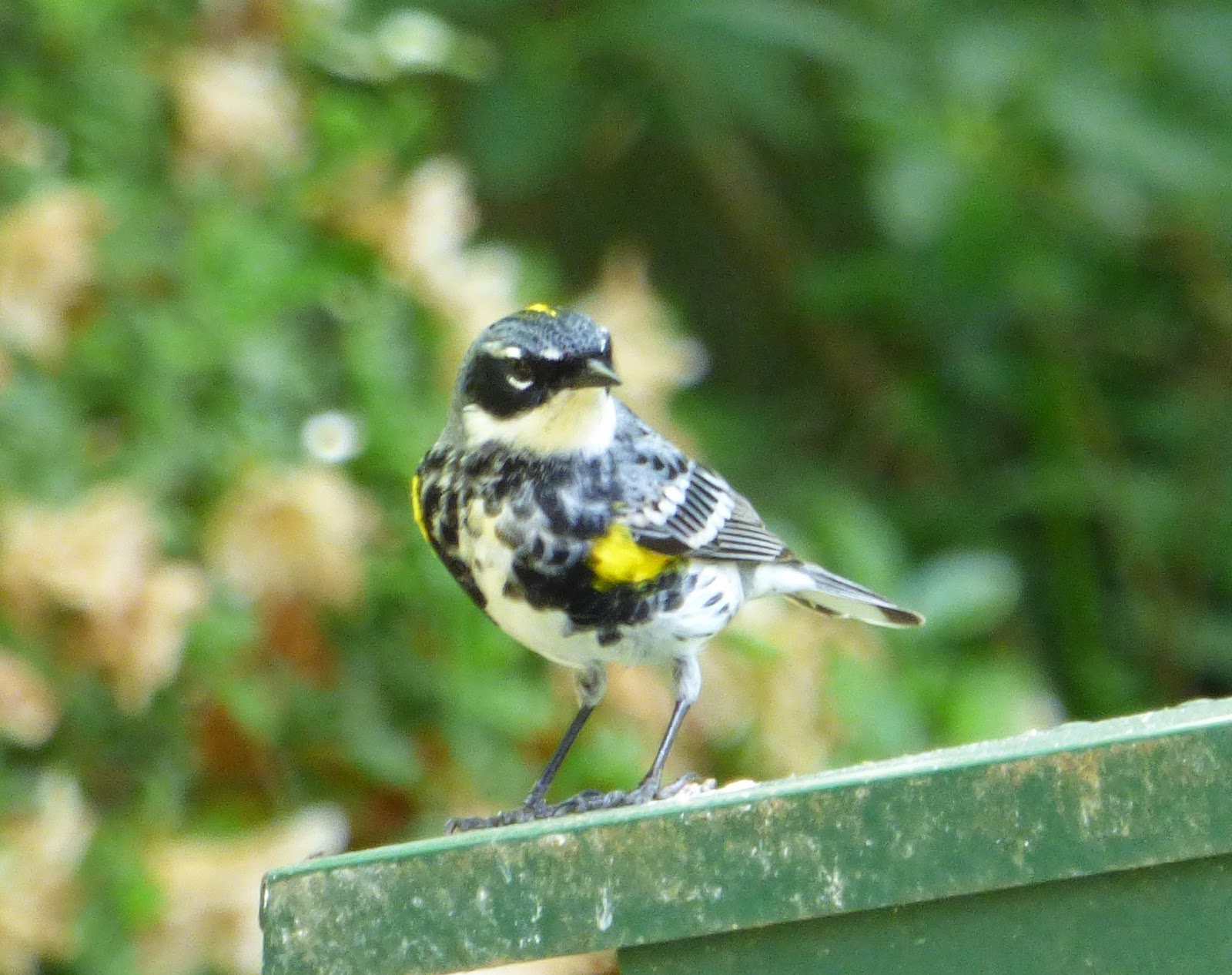
This dazzling male Yellow-rumped Warbler has been coming to the suet feeder recently.  He has transformed quite a bit since the winter when there were ten or more at one time frequenting the feeders.


This member of the wood warbler tribe has a large patch of black feathers on his cheek and another surrounding his bright yellow shoulder splotch. There is a streak of yellow on his crown as well as the definitive yellow rump patch that gives these birds their common name.


Wood warblers are primarily insect eaters.  Their sharp thin beaks are well adapted to catching these food items.  In the east, this species was formerly named Myrtle Warbler because of the large numbers of wax-myrtle berries (also called bayberry) they consume.  Most other warblers are not able to digest these waxy berries.  The Yellow-Rumped Warbler's ability to strip off the waxy coat during digestion actually aids in the germination of the wax-myrtle seeds later.


The male Yellow-Rumped Warbler has a bright white throat and belly in his summer plumage.


Wednesday, August 27, 2014

MID-JULY "MOTH HUNTING" WITH THE GRANDSONS (AND OTHER CREATURES)


With the grandsons visiting from Georgia, we decided to set up an inaugural event for our "moth pit", not to be confused with a mosh pit (no wild dancing allowed - see: (mosh pit)). Earlier I had ordered a mercury vapor lamp which I modified for the moth viewing area.  I suspended an inexpensive large white bed-sheet from a piece of 1/2" conduit and draped the sheet over a folding table.  I placed the mercury vapor lamp on a plastic crate which I set on the folding table. At the other end of the moth pit, I hung another bed-sheet and suspended a black light in front of it.  

One of our first customers was this Brown Marmorated Stink Bug (BMSB).  I've read that this species was accidentally brought here from China and can cause damage to fruit trees and crops such as corn, soybeans, and tomatoes.


Our first moth visitor was this black and white beauty, a Grape Leaffolder Moth.  Their caterpillars feed on grape leaves and make their cocoon by folding part of a grape leaf and "stitching" it together on the open sides to form an insulated pocket in which to transform into its adult moth form.  


Soon we had another moth visitor.  This lovely moth is a female Pink-striped Oakworm Moth.  My wife had seen a pair of these moths a couple weeks earlier.  Their fuzzy head is quite luxurious.


Next up was this Skiff Moth.  It is a chunky little moth with chocolate brown side "panels".  The "What's That Bug" website describes the caterpillar of this moth as a harmless species of the "slug caterpillar" family some of which have spines that can deliver a painful sting.


Soon this robust beetle with pincers flew in and landed on one of the sheets.  


One of the twins let the female Reddish-brown Stag Beetle take a ride on his finger.  These so-called "pinch bugs" are pretty harmless, but a bit scary looking.  One of the characteristics of this stag beetle is the yellow-orange color of the femur (thigh bone).  The larvae of this beetle, large "C-shaped" grubs, feed on rotting trees and logs.  The adult beetles feed on sap.  I read that captive adults can be fed maple syrup or sugar water.


About a month later this male showed up one evening.  The males use their sickle shaped "pincers" to wrestle with other males for the chance to mate with a female.


Below is a close-up of the female Stag Beetle's antennae.  I read that the stag beetle's antennae usually have ten segments.  Many species have the segments at the end of their antennae enlarged, and some species, like this one, have elbow shaped antennae.


This is a close-up of the male stag beetle's antennae and mandibles.  See if you can count the ten segments.  The one closest to the head is a long segment.


We found a few other moths that evening, but I have not been able to identify them to this point.  But the biggest hit of the evening was a Brown Garden Snail that the boys positioned to see if it could crawl up the vertical portion of a concrete step.  They were impressed that indeed it could!  I did not get a photo of it that night as I was busy tracking down moths and beetles, but I did get these pictures last fall of a Brown Garden Snail on the leaf of an October Glory Red Maple.  


The boys also spent quite a while following three large Leopard Slugs that glided around near the edge of the Moth Pit.  I did not get photos of them either, but here are a couple links to pictures and interesting facts about these handsome mollusks.


========

Sadly, the grandsons were gone too soon, back to their Georgia home.  So we've continued our hunts for more of nature's creatures from our respective environs.

========

Back at the lab I found this remarkable Clymene Moth wearing a dagger-shaped (or cross-shaped) marking on its back.  Its hind wings, which are covered here, are bright yellow. My sister found one of these moths just two weeks earlier at her home in Washington, PA.  This moth is in the Tiger Moth family and its caterpillar is quite spiky like its cousins the woolly-bears.  Here is a link about how to keep a woolly-bear to observe for a while. (link)


At home by the light at the side entry door, we found this beautifully iridescent moth with pale gold along the front edges of its wings.  Its antennae gracefully trailed back over its pearly wings.  I emailed a copy of this picture to "What's That Bug". They identified this winged beauty as a moth with the sscientific name, Stemorrhages costata  (link).  Later I found references to an almost identical moth know as Kimball's Palpita Moth (Palpita kimballi)  (link)  that is more common in our area.  I need someone to show me the difference!


Nearby we found this gorgeous Tulip-tree Beauty Moth.  It stayed in the same spot for two days before flying away. The caterpillar stage of this moth is one of our largest measuring worm or geometer ("earth measurer").  


On a Sunday morning late in July as I passed the pottery jug birdhouse of Carolina Wrens on the way to potty the dog, I noticed that the wrens seemed to be hanging out of the nest, sort of on "their front porch".  They'd be flying within an hour or two as we soon found out.


My wife called me to the living-room to see four little birds fluttering around on "our front porch".  We went out to investigate and as we tried to locate each of the four babies, I felt something alight on my left should.  My resourceful wife grabbed her i-phone and took this picture.  The little bird sat there for nearly a minute before fluttering off after his nest mates!  We're not sure if it was reminded of the nest it had just departed when it looked at my scruffy face.


Taking a leisurely walk behind the lab I found this Carolina Mantis on a Winterberry Holly bush.  It had some sort of winged insect in its grasp.


The mantis always seems to be looking my way no matter where I moved.  So I headed on to the next bush so that it could finish its meal in private.


On another Winterberry Holly, I found this odd looking creature.  It took me a while to Google up the identity of this caterpillar.  When I first saw it on the leaf, I was reminded of a partially washed off bird splash.  I also couldn't figure out the material that was suspended seemingly in mid-air between its front end and its back end.  I learned that this is the caterpillar of the Harris's Three Spot Moth.  The suspended material is actually the remains of the head that it shed when it last molted and it is attached to wiry hair-like structures on its body.  These caterpillars use these "old heads" in one of its defense strategies.  


I found this interesting moth on the back window of the lab. The unique silvery markings on its wing helped me confirm its identity as a Soybean Looper Moth. 


This Black and Yellow Mud Dauber gave me a chance to capture the iridescence of it wings.  This is the species of mud dauber that built its nest of twenty or so mud columns in one of the Bluebird nest boxes at the lab.  That nest is pictured in my July 2014 post.  I've added the following link that shows the number and variety of spiders that the mud dauber paralyzes and stores in each nest chamber to feed its developing offspring.