Pages

Showing posts with label Tufted Titmouse. Show all posts

Monday, May 18, 2015

NEST BOX CHECKS MAY 12TH TO 15TH


This has been a busy week in the nest boxes at home and at the lab.  A total of 12 young Eastern Bluebirds successfully flew out of their dark and protective nest boxes into a big bright new world.  Here is the recap.


LAB BOX #1

I checked on the nest in Lab Box #1 twice this week and found either the mother on the nest or one of the adults calling from the tall Loblolly pines nearby.  I am hoping to find hatchlings when I monitor the nest box on Monday (May 18th).


LAB BOX #2


Lab Box #2 had an eventful day on May 12th.  When I removed the plastic nesting cup from the box about 10 a.m. to check the 19 day old nestlings (16 to 21 days is typical age for fledging), one of the three young birds looked up at me and immediately flew strongly straight out from the nest and curved slightly to the left down the hill about 200 feet before landing in a 20 foot maple tree, one of a few young trees that line the drive leading to the lab parking lots.  Within just a few seconds one of its nest mates took off and followed almost an identical flight path. Not long later I could hear the parent birds calling to these first two fliers. The third young bluebird spent a minute or two tucking its head into the bottom of the nest in an effort to hide.  Here you can see the last nestling peeking at me with one of the two eggs from the clutch that did not hatch.  I placed the nesting cup back in the box and checked the box again that evening to find that the third young bluebird had fledged as well. These were my first three fledgling birds of 2015.  I removed the old nesting cup, washed out the inside of the nest box itself, and placed a fresh nesting cup inside in the event this bluebird pair decides to nest again this summer.  Later in the afternoon I opened the unhatched eggs and found nothing but yolk in one egg and just the tiniest amount of tissue in the other.  


LAB BOX #4

The Carolina Chickadees in Lab Box #4 have developed their characteristic black cap.  The five of them seem to be keeping the same arrangement in the nest as they did last week, looking a bit like wedges of pie.  Notice the feathers expanding from their feather sheaths on the nestling nearest my fingers.  They look rather like makeup brushes that I've seen in my wife's makeup kit.  This visit was on May 13th.


LAB BOX #6

The Carolina Chickadees in Lab Box #6 are just a day older than the chickadees in Lab Box #4.  You can see that their wing feathers have emerged even further from their feather sheaths.  This nest of five chickadees seem to arrange themselves in more of a disorganized pile than the orderly circle that their colleagues on the other side of the lab have chosen.


LAB BOX #7

The most recent nest at the lab also belongs to a pair of Carolina Chickadees and is located in Lab Box #7. On May 13th there were still five eggs being incubated.  This box is at the end of a section of parking lot near the lab and may offer a chance for me to share a view of the little chickadees to a few lab mates late next week.


HOME BOX #1

I checked on the Eastern Bluebirds in Home Box #1 on the morning of May 12th before heading to work.  All five young 18 day old birds looked healthy and fully feathered.  That evening, I put several live mealworms in the driveway and sat in my car hoping to get a few photos of parent birds taking food to their young charges. After sitting for a while and not seeing any activity, I got out of the car and checked the nest box.  It was EMPTY!!!  So these were bluebirds 4, 5, 6, 7, and 8 to fledge on this day!


HOME BOX #2


In Home Box #2 the little 15 day old Brown-Headed Nuthatches are fully feathered on May 12th.  The characteristic white patch on the nape of their necks is quite evident.


I lifted one of the young nuthatches out of the nest for a closeup photo. It promptly made a deposit!  Its dagger-like beak will be put to good use in just a week or two as these tiny birds are fond of fishing out insects from behind bark as well as splitting open sunflower and safflower seeds.  I read somewhere recently that some nuthatches have been seen using a piece of bark to wedge behind the bark of trees to expose deeper insect hiding places.


HOME BOX #5


On May 13th the elevated Home Box #5 still holds six little Tufted Titmice.  They are feathering out nicely and I've enjoyed watching from the window as both parent birds busily carry food to their young.


HOME BOX #6


I checked in on Home Box #6 on daily from May 13th (photo) through May 15th. The father bird nearly brushed my shoulder on one dive bombing run.  Early in the morning of May 15th these four nestlings became Bluebirds 9, 10, 11, and 12 to fledge from the nest boxes I've been monitoring.


HOME - RUBBERMAID TRASH CAN


In the late afternoon of May 12th as I began to ready the Moth Pit for luring in various nighttime visitors in the next week or so, I stumbled upon a mass of wheat straw, grasses, small twigs and thin pieces of plant roots in the bottom of a nearly empty light blue Rubbermaid trash can.  Upon closer inspection, I found four whitish eggs speckled with tiny flecks of reddish brown.  This is the nest of a Carolina Wren, but was it active?  I waited until after 9 p.m. and slipped out to take a peek.  I could no longer see the eggs, but could barely make out the beak of the mother wren.  The wrens are such a resourceful bunch!  The next evening there was a fifth egg and the mother bird seems to have set about incubating.


Saturday, May 16, 2015

VISITORS TO THE BIRD ROOM AND DECK


Ruby-Throated Hummingbird

Last Saturday I spent a sometime watching birds from our bird room and the deck. Our first visitor was this male Ruby-Throated Hummingbird.  Like all hummingbirds he was quite busy.  So far this is the best photo I've been able to get.  His gorget appears black in this photo because the sun's rays were obscured by the mature White Oak trees on the south side of the deck.


Eastern Bluebird

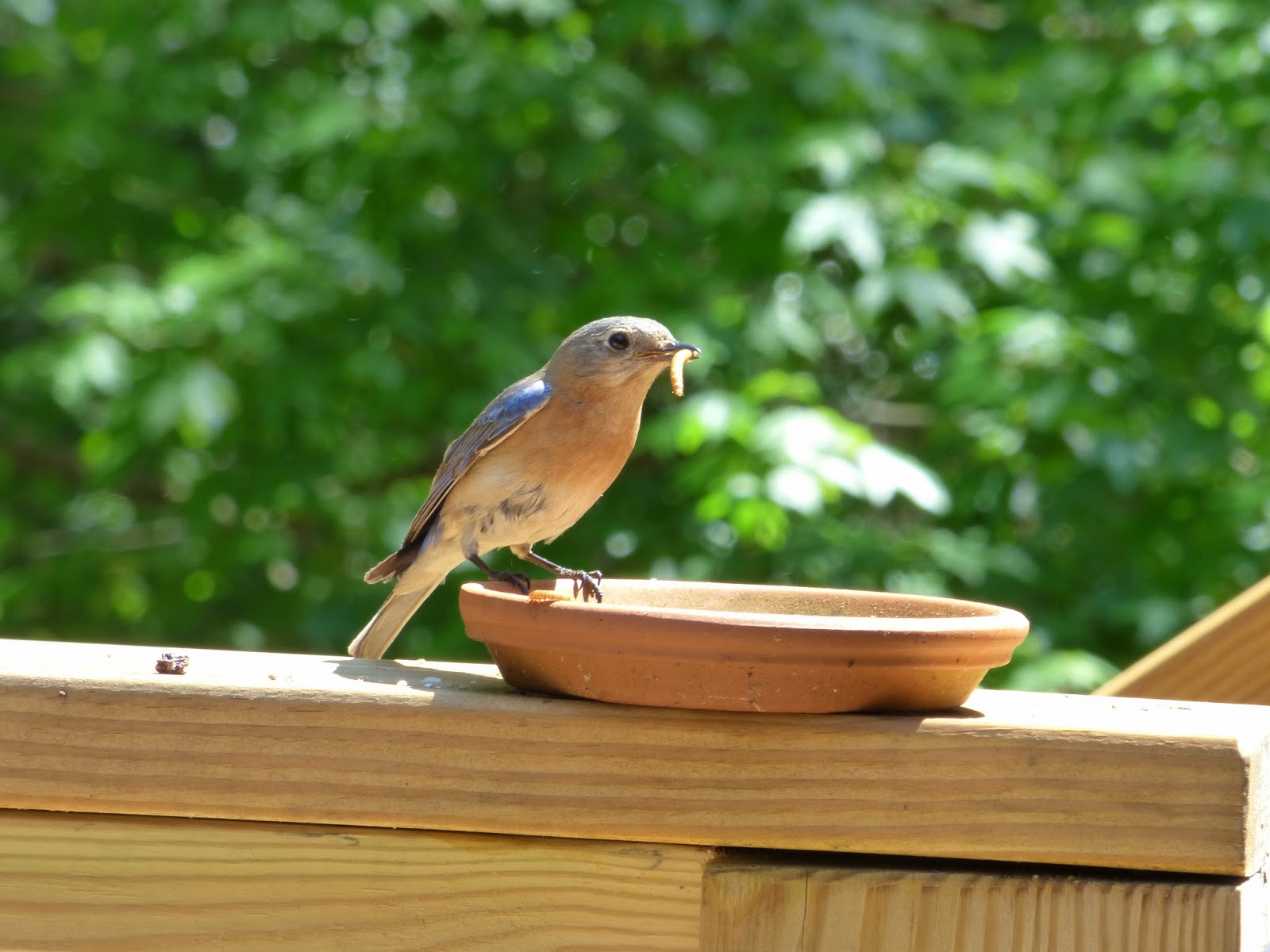
This male Eastern Bluebird was checking the terracotta saucer for live mealworms. His four young nestlings are just five days from fledging and he is as active as his mate in feeding them.


Back inside the bird room, I left the windows open again with a plastic tub of live mealworms on the table nearest one of the windows.  It wasn't long before the female of this pair showed up. She gave me a cautionary glance as I sat quietly with the camera on the other side of the room.  


She gave a few quick wing beats to balance herself as she picked out the one she wanted.  I just love the soft beauty of these female Bluebirds.


She secured the mealworm before flying back out of the window to the nest box that holds her four nestlings.


Carolina Wren

One of the bravest birds is the Carolina Wren.  For such a small bird they have a huge voice.  They creep and skulk around, often close to the ground before darting inside.   The wren's tail is characteristically held in a jaunty position and is rusty brown and marked with dark brown bars.  Their throats and bellies are buff in color and they have pink feet.


Two other characteristics of Carolina Wrens are the long white stripe over the eye and the longish, slightly downward curving beak.  I have been wondering where this bird might have nested.  The pair usually exits the window and then dives down under the deck to some remote location.  I had been looking around to see if I could find their nest, but was very surprised this week when I found a Carolina Wren nest in the bottom of a large Rubbermaid trashcan in the corner of the Moth Pit.  I could see four eggs in the nest around 6 pm that evening.  I returned after dark and peeked over the edge of the trashcan to see just the beak of the mother bird protruding form the nest's opening.  Two mornings later when she was away from the nest, I counted five eggs.  I have a new nest to monitor!


Carolina Chickadee

At least one Carolina Chickadee visited the indoor mealworm feeder.  These little birds are also brave around humans.  They have a soft gray back, a whitish belly and cheeks, and a black cap and throat patch.  We had a nest of chickadees in the yard last year, but this chickadee seems to fly into a neighbor's yard with its mealworms.  At the lab there are currently three active chickadee nests.


In this photo you can see how small the chickadee is using the mealworm for comparison.  They are probably two-thirds the size of the bluebirds.


Tufted Titmouse

The final visitor for the morning was this Tufted Titmouse.  This relative of the little chickadees has a soft gray back and head with a crest  that it sometimes lays close to its head.  Its undersides are whitish with a touch of orange under its wings.  


 Last May we had a nest of titmice that failed about a week after the babies hatched. Something apparently happened to the mother bird.  This year there is a nest of six babies that are now well feathered.  I watched today as both parent birds made frequent trips to the nest with food.


Sunday, May 10, 2015

NEST BOX CHECK - MAY 8TH AND A BOLD JUMPER!

I made the rounds to the active nests on Friday afternoon. Here is what was going on.


LAB BOX #1

In Lab Box #1 the Brown-headed Nuthatches have a total of six eggs that are white with reddish brown splotches especially concentrated around the large end of the egg. They should be hatching in around a week.


LAB BOX #2

In Lab Box #2 the three Eastern Bluebird nestlings are fully feathered and getting big.  They should be fledging in the next two or three days.  The plastic nesting cup has a lot of what appears to be fecal debris around the edges.  I have not seen this before.


LAB BOX #4

In Lab Box #4 there appears to be a chickadee pie, divided into 5 wedges!  These little Carolina Chickadees have about ten days to go before leaving the nest.


LAB BOX #5

In Lab Box #5 I found the five eggs still unhatched eight days past the usual incubation period.  I had noticed some change in the coloration of the eggs a few days ago that was similar to a nest last year where the parent birds seemed to have disappeared during incubation.  On advice from a bird researcher at the NC Museum of Natural Sciences, I removed the nest, cleaned out the nest box, and replaced the old plastic nesting cup with a new one on the chance that the bluebird pair will begin a new nest.  At the museum staff's request, I delivered the nest cup with the nest and four of the eggs to the lab facilities at Prairie Ridge EcoStation for potential examination by a new researcher who specializes in bird eggs.


I took one of the eggs to my lab for a close up photo.  You can see the demarcation line that corresponds to the air cell at the large end of the egg.  The area of the shell over the air cell is more like the original shell color.  The rest of the egg is a shade or two darker.  I opened the egg from the large end and could see a network of blood vessels just beneath the membrane.  When I further opened the shell I found a lifeless embryo that was developed enough to identify its eyes, beak, and very tiny legs and wings.   It is hard to know what caused the end of the development of these eggs, although we did have temperatures in the upper thirties at least twice during the first week after incubation would have commenced.


LAB BOX #6

In Lab Box #6 the Carolina Chickadee young are thriving. Two of the five immediately popped their beaks open hoping for insect meal.  The fledge date for this clutch is in about a week.  You can see the eyes beginning to open on these little birds.


LAB BOX #7

In Lab Box #7 our unknown bird (chickadee or titmouse, I think) has five eggs. Perhaps in ten days these eggs will have hatched and I'll see the parent birds flying to and from the box with food items.


SPECIAL SPIDER TREAT!!!

On Thursday I found a black jumping spider on a wall in the hallway that separates our Cytology Prep Lab from the Chief Medical Examiner's Toxicology Lab.  I scooped the spider up in a plastic lab bottle with lid and released it today while I was out checking nest boxes.  I placed it on a facility structure about 4 feet off the ground.  It immediately leaped to the ground, but I was able to get a few blurry pictures plus this decent one.  At home Friday evening, I zoomed in on this photo to admire the typical "sports car-like headlights" that all jumping spiders have for eyes.  But I was astonished by the metallic green jaws (chelicerae) between its pedipalps.  The pedipalps appear to be slightly "clubbed" at the ends.  If so, this would be a male spider.  I am seeking conformation on the gender.  But I did learn through Bugguide.net that this is a Bold Jumping Spider (AKA Daring Jumping Spider) with the scientific name Phidippus audax.  The big forward facing eyes are instrumental in their hunt for insect prey and also in the dances that this group of spiders employ in seeking a partner.  These spiders are not prone to biting humans and should be a source of interest not fear.  A new acquaintance on Facebook who is a retired park ranger wrote me that placing a mirror in front of a male jumping spider can produce an entertaining show.  The male jumping spider often puts on a display in an effort to scare away what he thinks is another spider of his species.


HOME BOX #1

In Home Box #1 there are five well feathered Eastern Bluebird nestlings.  You can see a little bit of blue in the wing feathers of the bird on the left (could be a male). They should be ready to fly by midweek.


HOME BOX #2

In Home Box #2, the Brown-headed Nuthatch babies are getting their "shark-tooth" shaped beaks!  If you look closely, you can count all six nestlings.  It will probably be near the middle of the month before these birds take flight


HOME BOX #5

In Home Box #5 the Tufted Titmouse nestlings are definitely hungry.  Here you can see five of the six mouths wide open.


When I opened the box, one of the nestlings was away from the other five in this very spacious nest box that was intended for Great Crested Flycatchers.  Before I moved the little titmouse back closer to its siblings, I just had to hold its warm little body in my hand for a few seconds.  It had no problem begging for food from this big old fuzzy fellow.  Sorry, I've got no mealworms on me at the moment!


Saturday morning I put out some mealworms in the terracotta saucer on the deck railing.  The Tufted Titmice were the first to arrive!


HOME BOX #6

In Home Box #6 the four Eastern Bluebird nestlings have plenty of feathers  They are just a a few days behind the nestlings in Home Box #1.  These babies seem have experienced parents.  They both dive bomb me whenever I check the nest. Neither of them are reluctant to grab mealworms from a clay saucer on the deck rail even when I'm nearby.


I hope to have more pictures next weekend!

Tuesday, May 5, 2015

LAB NEST BOXES ON MAY 3RD


On Sunday May 4th I drove over to the lab to check the eight nest boxes there. Here's what I found.


LAB BOX #1


The Brown-headed Nuthatches in Lab Box #1 have filled out their nesting to a total of six eggs.  I look forward to seeing this bunch hatch.  It is in a location where I can invite a few folks to see the little ones when they hatch.


LAB BOX #2


The early nest of Eastern Bluebirds in Lab Box #2 holds three young birds that are about 10 days old.  Two of the eggs in this nest did not hatch. You can see slivers of those eggs at 12 o'clock and 4 o'clock. The nestlings' wings are covered with feather sheaths that are showing little puffs of feather at their tips.  This stage always reminds me of paint brushes.


LAB BOX #4


The mother Carolina Chickadee in Lab Box #4 stuck tight to her nest on May 3rd as I peeped in.   I closed the box promptly to give her the privacy she deserves


A day later on May 4th I checked again and found that five of the six babies had hatched.  I will go back in a few days to see if the sixth egg was viable.  Four of the five popped open their little beaks when I did a little "pishing".


LAB BOX #5


The Eastern Bluebird eggs in Lab Box #5 still have not hatched.  I am concerned that this nest has failed for some unknown reason.  I plan to contact a friend at the NC Museum of Natural Sciences about how to proceed.  Most likely, I will remove the entire nest and replace it with a new nesting container in the hopes that this pair will try again.  I may open one of the eggs to see if there is any evidence that the eggs were ever fertile.


LAB BOX #6


The Carolina Chickadees in Lab Box #6 near the loading dock hatched on May 3rd. All five babies are active and responded to my "pishing".  I like the green fibrous stuff that a parent bird added to the nest cup.


LAB BOX #7


Much to my surprise Lab Box #7, which has been empty for the past two seasons, suddenly has a complete nest in it. The nest cup was covered over, but I gently laid the camouflage back and was able to observe two speckled eggs.


I'm not sure yet what is nesting here, but I'd guess another chickadee nest or perhaps a Tufted Titmouse.  I'll keep an eye out as this is an easy box to check on my way home in the afternoons.


Sunday, May 3, 2015

BABY BIRDS IN OUR NEST BOXES


I visited the Home Boxes around lunchtime today (May 2nd). Hope to go over and check on the Lab Boxes tomorrow.

HOME BOX #1

I found the Eastern Bluebird eggs in Home Box #1 freshly hatched on the evening of April 24th.  One of the eggshell halves was still in the nest.


On April 28th the little four day old bluebirds have doubled in size and are showing a lot of fuzzy down and the beginnings of feather tracks along their flipper-like wings.


On May 2nd these little guys are now eight days old.  Their eyes have not yet opened, but you can see the development of the feather tracks along the crown of their heads and down their backs.  The feather sheaths along the back edge of their wings are developing nicely.


The tip end of my index finger gives an idea of how much these babies have grown in the past 8 days.  You can also see the ear canal openings on at least two of the five nestlings.


I recently found a supplier for some nice lively mealworms to put out for the adult bluebirds to share with their babies (wrens and titmice are stopping by, too).   RedHen is a strong advocate for environmental conservation, and uses her yard to grow all sorts of edibles.  She is also a public school resources person who teaches students the importance of the four R's of Environmental Conservation: Reduce, Reuse, Recycle, and Rethink (Re-purpose).  In addition, she teaches them how to make what she calls "Black Gold", (rich, black compost to use in gardening) by employing earthworms to breakdown fruit and vegetable scraps from the kitchen.


I opened some of the windows in our little "bird room" for a while this afternoon so I could take a few pictures of songbirds at the feeders.  The plastic container in which I am storing the bulk of these scrumptious little mealworms was sitting uncovered on the table near an open window.  After being out of the room for a few minutes, I came back to find one of the mother bluebirds perched on the container's edge selecting the juiciest worms for her babies.


I also tried out the video feature on the new camera.  Here is that beautiful female Eastern Bluebird waiting for me to leave the "bird room" again.


HOME BOX #2

On April 28th the Brown-headed Nuthatches in Home Box #2 hatched.  There were six little eggs just the day before and I am pretty sure there are six little hatchlings somewhere in this pile of avian tininess.  They are smaller than my thumb nail. 


On May 2nd these little guys are four days old and they are not shy about asking to be fed.  The adult nuthatches are shuttling back and forth to take care of these six siblings.


Their yellow gapes are trimmed with white borders to give the adult birds good targets for placing food items in the darkened cavity of the nest box.


 There are definitely six little beaks (or parts of beaks) visible in this picture.


HOME BOX #5


May 2nd appears to have been hatching day for the young of the Tufted Titmouse pair that nested in my "big" Great Crested Flycatcher nest box which is mounted on a ten foot pole.  As we look out from the windows of our back bedroom, the box is rather hidden from the view by the leafy branches of a Winged Elm, so I had made my earlier supposition of which species had built this nest on its composition.  I assumed from the mossy material I had encountered in Carolina Chickadee nests over the past years that this was a chickadee nest.  Just a few days ago as I tapped on the pole before lowering it to check the nest's contents, I thought I caught a glimpse of a White-breasted Nuthatch fly from the box.  Well, today it was obvious that it had been a titmouse pair all along.  The parents are coming to the deck for live mealworms to supplement their hatchlings' diet.


This little titmouse has its head up and mouth open, ready for the next morsel from mother or father bird.


I can count at least five hatchlings, but I am hoping there is a sixth underneath as the mother bird laid six eggs.  I should be able to tell next week when I check on the nest again.


HOME BOX #6

The Eastern Bluebirds in Home Box #6 probably hatched early on May 28th.  I visited in the late afternoon and all four chicks look pretty dry.  Both parent birds dive-bombed me pretty strongly during the 20 or 30 seconds I was at their nest box. Adult birds do "love" their babies!


On May 2nd the four little four-day old bluebirds are all snuggled in.  They have a solid pair of parent birds watching over them and keeping them well fed.


 This picture was taken a few seconds later with no flash.


This is a Male Eastern Bluebird at one of the saucers I placed on the deck railing today to "hold" live mealworms.  I see two trying to escape!  This male is a brave individual who has dive-bombed me so closely when I was checking his nest that I could feel the wind from his wings.


This is the female Eastern Bluebird mate to the male bird above.  She often carries more than a few mealworms in her beak at a time to feed her four babies.